Spring
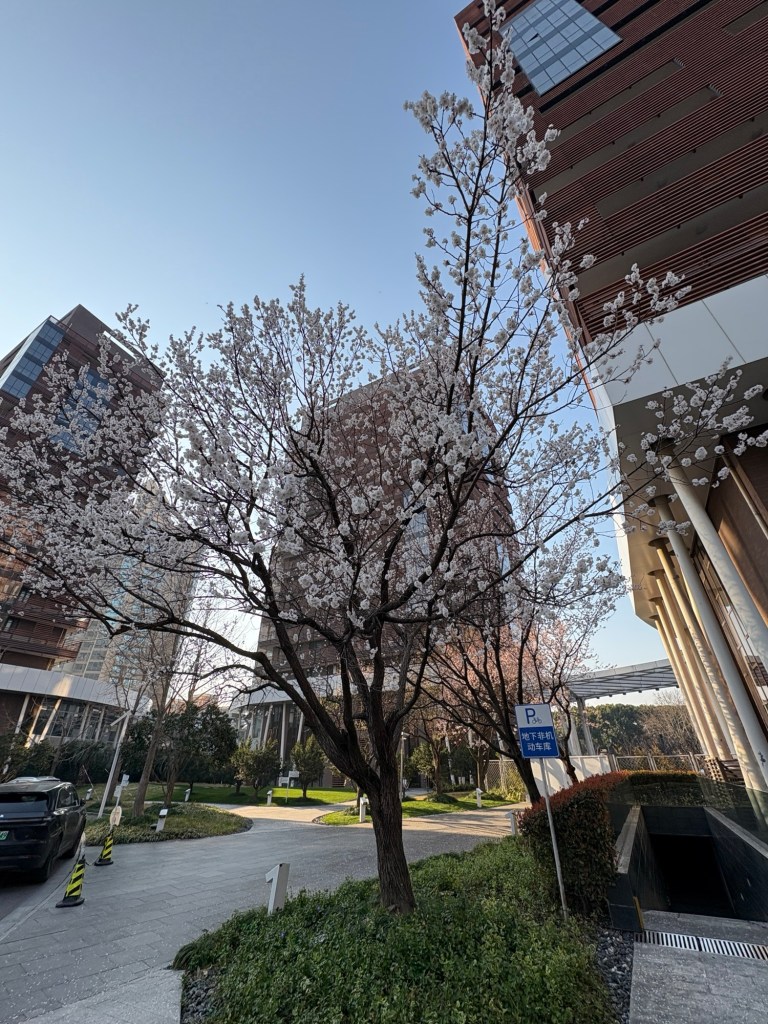
March 21
when spring pops
peach blossoms
out of spindly wood,
sharpens the hued blue
and your skin picks
up the unmistakable
promise that this chill
will turn into a prickle
of warm, cooling sweat—
all that’s inside
your body
wants to be unleashed
into this atmospheric
joy
Adventure: from Cairo to Shanghai
Twenty-five years ago, I wrote about my adventures in Egypt in a group email after one of my first days in Cairo. I was electrified by a visit to these twin mosques in the city that were bigger than any house of worship I had ever imagined. I bribed a watchman to let me climb the pitch-black, bat guano-covered stone steps of a turret up to the top of a minaret that stood perhaps 100 meters above the street below. The wind up there wasn’t strong, but it was steadier than my feet underneath me, and the consequences of wobbling too much weren’t abstract. There was no railing on top of that dollop of marble. My heart raced. I was short of breath. And then, looming in the far distance were the hulking pyramids. Giza was maybe 5 miles away? Maybe 10? They were almost mirages, so far away, so big, so fuzzy— the sandy grit that hung in the air offered a haze that only a wonder of the world could cut through. I went from breathing heavily from distress to outright breathless in amazement at their sight. The adrenaline kicking through me had a new name in that instant: Adventure.
That moment pressed itself into me. I think about it now as I try to describe what it’s like living in Shanghai. I’ve been here for 4 months. I’m middle aged now. I moved here not for adventure but for employment. My wife and I seek to create routines for our daughter and ourselves to make this new place feel like our home.
This week, I finally wrote a description of my impressions here — topics include the weather, the electric motor scooters riding on the sidewalks, trees, apartment buildings, the scale of this city, what you can get delivered to your door.
There have been no minaret adventures.
Part of this shift in what constitutes an adventure is perhaps predictable based on stage of life, although a little over a year ago I did not know we were going to be living in China. Unpredictability at this stage in life is not the same as it was decades ago – part of what made that day in Cairo so potent was it was my first time traveling outside of the U.S. on my own, and being launched into the world like that was exhilarating in a way that might be hard to duplicate in similar circumstances.
In another way, though, I think that adventure might be increasingly harder to have because of the devices upon which we are now so dependent. In Shanghai, my phone is my ticket to everything, literally. I haven’t made one cash transaction since I arrived. I order food, groceries, Halloween costumes on apps on my phone (not my computer). I translate spoken words and printed writing with two different apps. I use the maps and compasses to navigate. My bus tickets and metro fares are paid via an app.
(Another memory from Cairo: getting on a bus and not having the fare, which I think amounted to 3 cents and was printed on a piastre note so small I thought it was a bookmark when I saw it. The man next to me paid my fare and said, “When you’re in Cairo, you don’t have to worry.”)
Historically, getting lost is pretty common for me. Following verbal directions has never been a strength— I routinely lose my way driving in my hometown. So in new locations, especially cities with long histories where roads aren’t straight or marked or where there are cab drivers who play the game “get as close as you can to the foreigner crossing the street” I need a lot of directional support. There was a driving trip in Costa Rica once where I was on a road trying to get back to San Jose. The road went over hills with lots of turns and junctions. I stopped constantly for directions. My Spanish was so limited that I had to set up every question so the answers were either “yes” or “no” (San Jose está allá — si or no?”).
In Shanghai, I haven’t had to ask a single person for directions. I don’t know what I would say if I had to — I haven’t acquired any language proficiency yet.
Moving is a struggle. You uproot everyone in your life. And then you try to get back into balance, routine, homeostasis. It’s different from the struggle to communicate how to find the bus, train, taxi combo to get to that village you heard about from the one person who spoke English at the tea stand yesterday. The distance and time between hugging the dome on top of that minaret in Cairo and ordering a gluten free frozen pizza to be delivered to my door in Shanghai feel further apart than 25 years and the leaps in technological capacities. Adventure once was an experience related to how out of place I felt in a new surrounding; now, Adventure is measured in how easily I can feel a part of a new place.
I like it here. I know how to navigate the city. In most things, I feel I can mostly find my way. The adherence to a routine that offers me the energy to self-direct here is what counts as an adventure. I will not seek to find the top of the tallest buildings in town, but I will seek the little cozy corners where I feel like I’ve had an experience that’s mine.
And then I’ll lay my head down at my regular bedtime and get into my routine for the next day.
Tri for Fun

I did a thing! Last month, I finished the Jinshan triathlon with my new colleague-friends from my new school. My performance in the race was objectively satisfying – personal bests in two of the disciplines! Even better: the connection I felt with the other Eagles (our school mascot) who also raced that day was by far the highlight for me.
Those who give advice about doing triathlons say the key to these silly races is finding a way to get comfortable within great discomfort. There were 9 of us from the school who participated in the race, and every one of us had some noticeable level of discomfort. Four were doing their first triathlon ever. That’s a special experience like drinking from a fire hose of new information and trying to imagine something that has only existed in theory until race day. One was doing her first race in almost twenty years; she was wondering if her body and mind would remember that this is something she could do (again). Several of us held active fear about swimming in open water, about meeting performance-based goals, about being overwhelmed by the details of transitioning quickly from phase to phase, about meeting time cut offs. Many of us wondered if we’d done enough training to be ready. There were concerns about equipment and nutrition. Being new to the country, my biggest obstacles we getting a bike (a new friend loaned me one), figuring out how to get to the race location, booking a hotel, and then I had a moment during the practice swim the day before the race when the wind was smacking waves right into my face when I was supposedly doing an easy 300 meter water test.
Most of these vulnerabilities were shared as we talked in the days leading up to the event, and it led to just the right amounts of encouragement. Sometimes it was a pep talk, sometimes a piece of advice about preparing gear, or even just organizing the transportation to and from the race site. The mutual support and sharing of experience brought about a particular form of cohesion and seemed to make all of it easier.
The race was only 84 days after I first arrived in China for a new job. In every part of my training and race experience I was connected (often reliant) on others. There were a lot of big training achievements for me in the last 2 months, so I was excited for race day. However, triathlons are full of a range of often contradictory experiences. My favorite moment was when I made the turn on the run to begin the final loop. My new friends were sitting on the concrete wall overlooking the u-turn that marks the halfway point of the run course. As I approached the cone, I was cooked and really wanted to be done. My friends cheered like crazy when they saw me – it was a kind and generous moment. Their energy gave me the boost I needed to keep running out of the turn and into the last stretch of the course.

My friends sitting along that wall on that overcast Saturday morning had already finished their races. They’d experienced their individual moment of “I did it!” and had begun their recovery. It’s not a big stretch to imagine that they could relate to what I was feeling at that moment when I came running up to the turnaround. However, they couldn’t have known how much I needed them partly because I didn’t know it myself until they were whooping and cheering. They were there. And they cheered.
And I won’t forget it.
It’s good to be here!
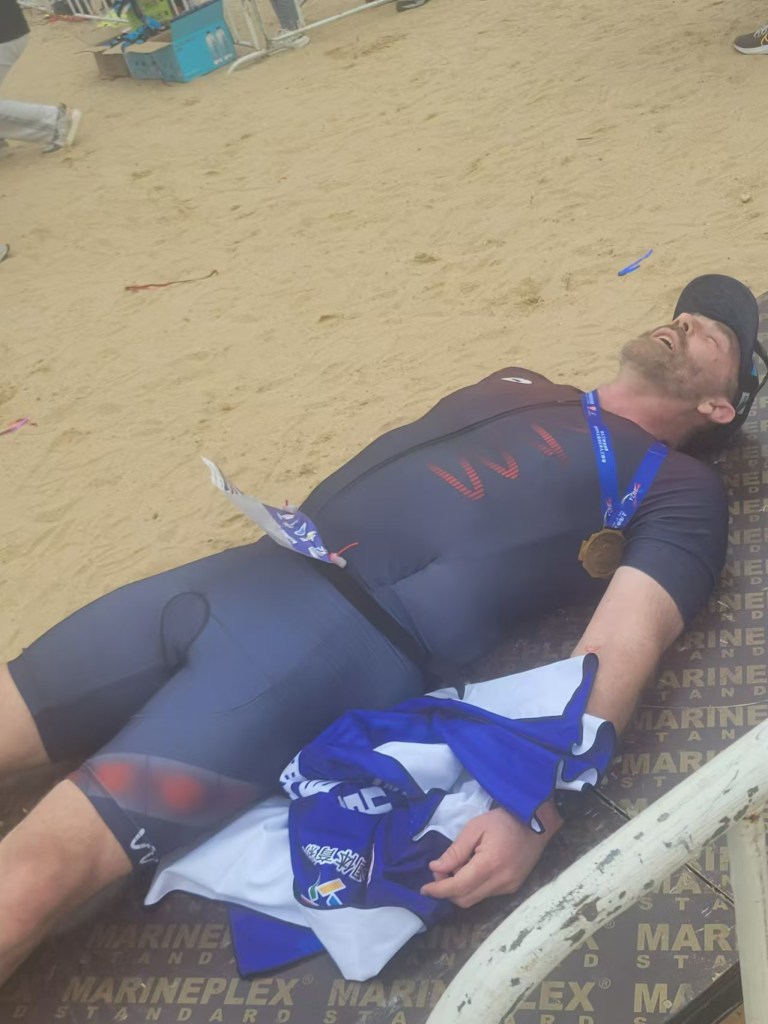
My “Victory” Pose
Cicadas
The bugs here are incredible.
Cicadas, specifically. When we arrived in Shanghai midsummer, the cicadas were so loud that I often couldn’t hear what Susannah or Julia were saying when we were walking down the street.
Of all the ideas I had in anticipating Shanghai, this wasn’t one of them.
It has me thinking of the first time I learned about cicadas: I’d moved from a beach town in San Diego to Annapolis, Maryland, which, with a population of around 30,000, was smaller than my hometown.
While Annapolis has water on eight sides of it and is a state capital, you don’t have to go far from the steps of the Capitol building to reach working farms. In the time I lived there, I’d associated the summer hum of those dinosauric insects with the combo of summer humidity and small town life. So, I was quite surprised to get to my new home here in Shanghai – with a population of 28 million give or take – and have the constant sound of this city by the deafening cicada shrieks.
I’m thinking too about the unexpected sounds of the three other places I’ve lived since moving abroad. In Chennai, the early morning sounds were dominated first by the crows; in Bucharest, it was seagulls who cackled at sun up, followed by a lazy rooster in the neighboring courtyard; before the sun rose in Abidjan, bullfrogs ribbetted at each other in the deep concrete trench across the street from my apartment building. After the sun was up, a rooster up the street who thought he was a peacock showed off his vocals.
The sounds of international cities: crows, seagulls, roosters, bullfrogs, cicadas.
Collected Poetry Anthology
Greetings to my six enthusiastic readers… this Anthology has been sitting in my drive for over a year now, mostly because I haven’t been sure how to share it. Read away!
Rihanna’s moment
I haven’t watched a Super Bowl in 10 years. It’s been even longer since I saw a Super Bowl halftime show. And yet, after hearing and reading about the profundity of Rihanna’s halftime concert last month, I found myself watching it on YouTube. And again. And again.
No one would call me a Rihanna fan — I just don’t know her music. About half the songs of her setlist evoked this reaction from me: “oh, this is one of her songs?” Prior to this performance, I had never looked up one of her songs or pressed play on something in her catalog on Spotify.
So now I’m humming some of the hooks from her hits throughout the day. I even woke up last night with one bouncing in my head. Her Super Bowl show performance was incredible — the interwebs go on and on about that: iconic, fiercely low-key, exuding self-possessed confidence … she’s getting that kind of acclaim. And I keep going back to it. It’s a great show.
And, there’s one moment that stands out to me above all the rest. She’s surrounded by dancers the entire time. Hundreds of them. Then there’s a shift to a piece where a band is waiting for her on one of the platforms on the forever-long stage. She’s just a few seconds into the transition of the new song; there’s a steady but building intro. She walks up to a very tall man holding a base-guitar, and she gives him a fist-bump – the only greeting she offers someone else in her performance. For just a moment, the camera follows her with the base player in the background. It’s clear from the soft fist-bump that these two know each other. It’s a warm moment that flashes by, and then, in background, this giant man, a rockstar in his own right, dressed in tailored clothes for a Super Bowl performance – so in other words, is in this moment of time, one of the coolest cats on the planet – nerdily sings along (sans microphone) with Rihanna.
I’ve watched this video half a dozen times just to catch this moment. I love it. 13 minutes of ultra-precision and choreography, and a momentous moment of human connection.
See ya, Bucharest

I’m thinking about Holden Caulfield these days, and how on his last night at Pency Prep, he went alone after dark to a hill on campus that overlooked where the rest of the student body was watching a football game. He tells us he’s looking for a nice “goodbye feeling” — we come to learn in the pages that follow that the poor guy has suffered one loss after another without ever getting a chance to mourn, celebrate, appreciate.
Fortunately for me I have a few more skills than old Holden so I see him as a non example rather than a model. Still, saying goodbye brings up a range of memories and connections. The idea though of wanting a nice goodbye feeling is relatable, though, probably to anyone who moves from one place to the next even if the rest of Holden’s circumstances don’t relate.
For us, the coronavirus didn’t exist when we decided to come here; by the time we arrived six months later the world was a different place. And this place, this city, felt empty. I remember the first people in my neighborhood that I recognized seeing frequently were the homeless men occupying the nearby city park and the two middle schoolers who slowly walked the same loop each day, side-by-side, clearly crushing on each other and relieved to be out of the sight of their parents.
All the opportunities we hoped for getting to know this place the way we knew and loved our last place evaporated in the pandemic. As I prepare to depart, I wish I knew more about Bucharest and Romania. At the same time, this place offered our family exactly what we wanted and needed. Our daughter couldn’t yet crawl when we arrived; she learned to walk here. Now she runs, jumps, climbs. She walked all over and through the groves of trees in the three giant city parks within walking distance of our home, looking for sticks and rocks to pick up and carry. She stomped through puddles that pooled around clogged storm drains, and took great glee in going from playground to playground, asking to be pushed as high as possible on each set of swings she could find. On her last week of preschool here, her teacher reported that she was speaking in sentences in Romanian. The sentence? “Push me higher, more!”
The enduring benefit of this international teacher life is the opportunity to meet and befriend such great people who share our unusual and self-induced chaotic expat life. My slice of Bucharest has offered me a fulfilling combination of soulful connection with new and old friends. Saying farewell to these folks, and taking our squishy little kiddo out of the place where she began to really become a person are the hardest parts of this ending.
So I sympathize with Holden — leaving, then starting over, is always hard. And, I’m grateful for the gifts afforded us during these two years that could have been much, much harder. I’m down to less than two days remaining here. Instead of waiting for that nice goodbye feeling, I’m savoring the unique and the mundane moments which cobbled together made such a strange and wonderful experience here.
Leaving India

Last morning in India – A. Ranson
All it took for us to leave India
Was three days of packing up our house
Four different applications for travel passes
And a day’s worth of rushed goodbyes.
We spent nine hours on that bus.
Then five hours sheltering in an airport hotel.
Another five hours standing in line at the airport.
Before finally leaving on our ten-hour flight to Paris.
Nine hours in the CdG ghost-town terminal on a layover.
And eight hours on the transatlantic flight to JFK.
Twenty minutes to get our bags
And three minutes on an empty train
To pick up a rental car
For the two hour drive, and,
Inexplicably, not a lick of rush hour traffic.
All along this rushed departure,
Which also took forever,
Was gripping fear that we’d be turned away at the
Karnataka border, or the anticipation of
humiliating stupidity that we’d
exposed ourselves unnecessarily.
In Seat 14G, I found Relief, followed by a heavy Fatigue.
Packed down deep was stammering sadness
Wrapped in unmet expectations
About how I wanted to graciously leave
the place where I came into the
Life I’d always wanted.
The long road to Bangalore from Chennai
passes through the
Relentlessness of India;
All that is great and distressing on display.
A strange farewell.
Fitting or not. Here it is.
And maybe always will be.
India’s familiar heat pushed up
On all the windows, reminding me
How lucky I am, for even in our uncertain departure
I don’t have to worry if my baby
Will make it through this heat.
As ever, there is a buffer for people like us.
This long bus ride gives plenty of space for
A mind to go to all that could go wrong.
When the distress fills me,
I peer underneath her covered car seat to
Glimpse her perfect sleeping face or
Toothless grin when her eyes catch mine.
I didn’t imagine when I arrived in this great place
Seven years ago
That the strangers along side me
Also spilling with curiosity
Would become my wife, my dear friends,
companions who would flee their homes together
Clutching each other for security.
It’s fitting that our beleaguered leaving happened with
Each other. The love that binds us
Grew amidst Incredible India.
Where everything is true.
Fully Reopening Schools is a Fully Bad Idea
(AP photo/Francisco Seco)
Hartford, CT — High-level strategists will often ask “How do we screw this up?” as a way of evaluating problems with a new proposal. Upon compiling responses, the next step is to develop a scheme that effectively avoids the obstacles that are recognized. I’m thinking of this process for building sustainable, strategic plans to Connecticut Governor Ned Lamont, who announced on June 25th that all public schools in Connecticut will fully reopen in the fall. His plan calls for impractical norms such as requiring students to keep masks on the entire school day, follow strict social distance rules, and prohibits things like gatherings in the cafeteria. This plan is stunning in its absurdity; it is as if the governor and his team answered “How do we screw this up?” but then stopped there and just made their thinking at that point the policy they shared with the public.
The governor is understandably in a tight spot — Connecticut schools are a linch-pin in the state’s economic recovery. Parents who are surrogate teachers at home during virtual learning cannot also engage in work (or looking for work if they have already been laid off), so keeping children at home limits economic recovery. At the same time, the primary responsibility in a school is safety — physical and emotional safety is paramount in a school, for without it learning is impossible. Federal officials have repeatedly failed to lead a national response to the pandemic, so Lamont and his advisors are on their own to cobble together a pandemic response plan. However, even when weighing all these factors, the plan to fully reopen schools is short-sighted, impractical, and unsafe.
This plan will effectively turn teachers into enforcers of rules, not educators. Real learning will not be possible as teachers harang students to wear their masks all day or to remain at least six feet away from each other (just pause for a moment to think about your own experience as a student and recall the number of times you were in a classroom where it was possible to be six feet away from every other person in that room). Even if additional teachers can be hired to reduce the size of groups of students, as the plan calls for, their daily tasks in this plan won’t be teaching and students won’t be learning with their masks up and separated from others. Teachers are often the last stop, the group who will sacrifice what is good for themselves in order not to let students get short shrift. This time, their collective selflessness can’t make up for a terrible policy decision.
It is likely that a significant factor in this decision was the 12 week virtual learning experiment that occurred from March to June. By most (all?) accounts, student engagement during online learning was disappointing at best. It may be easy for the governor and others in similar positions to conclude that virtual learning can’t work, so schools need to reopened this Fall, at all costs. This conclusion though reveals a lack of understanding about online learning. When the ratio of students to teachers is significantly reduced (i.e.: 5 to 1 rather than 30+:1 typical in many public school classes) and the teachers serve as instigators or guides who support thinking rather than just sources of information, online learning is very effective and a powerful tool in supporting critical thinking skills, developing curiosity, and transferring understanding from one so-called subject to another. Trying to execute 3 months of online learning with no preparation or insufficient infrastructure isn’t sustainable. There is no way this method of school could succeed, and it should not be the thing the Governor is thinking about when he chooses to re-open schools in the Fall.
Luckily, state officials need not develop alternative models out of thin air. Organizations like Global Online Academy have created online learning options and well-designed tools that can be adapted quickly by teachers and districts. GOA, and other similar organizations, already have in place the architecture for online learning that can help students receive the engagement they desire and teachers the tools they need to connect with students through an uncertain time.
As the pandemic presents simultaneous economic, political, and emotional challenges that we have not encountered before, the pathway through these challenges cannot be based on business as usual. Governor Lamont’s plan does not demonstrate visionary leadership. Rather, it jeopardizes the health and safety of students and teachers by trying to return to a framework for education that is neither physically safe, logistically viable, nor pedagogically sound.
The Governor and his advisors would do well to postpone the start of the school year for up to several weeks to enable teachers and administrators the time to collectively study successful online learning models and develop the plans to successfully implement them. With a viable virtual learning model in place, Connecticut schools have a chance to serve students and families across the state. To continue with his plan as it was stated last week will only offer continued disruption in the short term; in the long term, it may be a textbook example in the future of how to make an unprecedented situation even more screwed up.
7 Months

Seven months ago, Susannah and I spent a lot of time in Target in Columbia, South Carolina. I think we were in the store 3 or 4 different times within a week. We were there enough to notice the dramatic shift from the autumnal hues of deep orange, burnt umber, and spiced pumpkin which flowed through all the clothing sections near the store entrance to the over-the-top ugly Christmas sweaters that were featured in all departments for the winter displays. On the morning of Halloween it was all Fall, Fall, Fall, but November 1st was full-throttle Christmas to the nines. Clearly, the displays left an impression on me.
That’s the week I became a father. Susannah and I traveled from the other side of the earth to get to Columbia so that we could be there for the birth of our daughter, Julia. Today, seven months later, a court in the great state of South Carolina has decreed, hereby legally and forever, that we are her parents and our adoption of Julia is complete. With the decree comes a settling deep breath. All those trips to Target were runs to stock up on what new parents need and because we were so excited we couldn’t really think straight so we kept forgetting to get stuff. What I remember most of the period just before our daughter’s birth was the omnipresent feeling of anticipation. I couldn’t really catch my breath. While standing in the diaper aisle or picking out a car seat, we were just waiting, squirming with excitement. And forgetting everything.
And here we are now. Back in India, settled into routines, filling up our phones with photos of this and this and this — because, no offense everyone, she is by far the cutest baby to have ever been a baby — marveling at how many different people, both known and unknown to us, were involved in the two of us becoming a family of three.
COVID 19 is crushing spirits around the world. It’s a scary time with so much unpredictability. And still, the life right here in front of me is deeply satisfying. Getting the notice today of the court’s decision affirmed what I’ve known since the moment I met her: I’m her dad. I also can finally take a deep breath.


 ransonnotes