The First Year
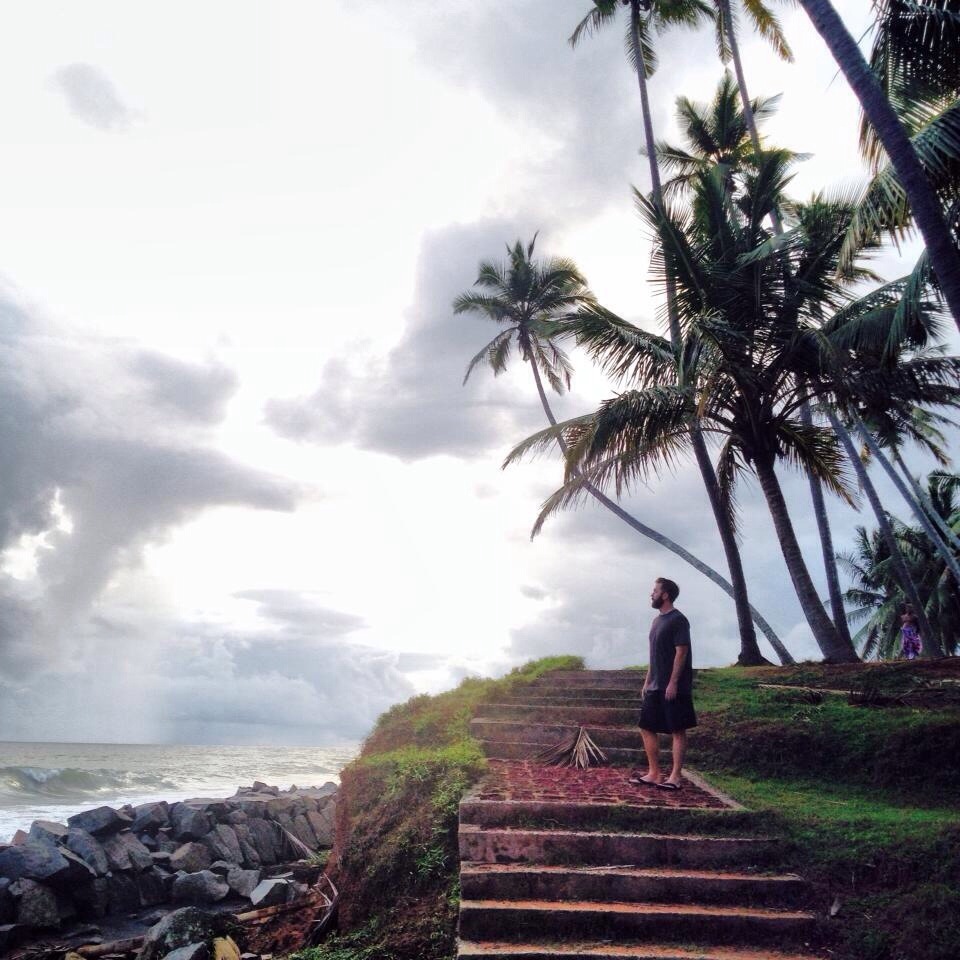
I just finished my first year in India, and I don’t know how to start talking about it. If you’ve followed my other posts you’ve seen that I’ve struggled at times with being fully present here, nearly drowning in the Ganges, getting sick, dealing with students who have learning needs I’m not accustomed to, and even the death of a colleague. That makes for the kind of year that requires new vocabulary. I’m certain I haven’t found the right words yet.
It’s a fact that there isn’t a single thing in my life that’s the same as it was a year ago, and if I look back on the past 18 months — which encapsulates the time when I accepted this job — it’s clear that this time has been filled with unparalleled change. In recent weekly brunches with my friend, J, we’ve talked about how life-changing experiences and decisions in The World come at a rate of one every couple of years, maybe every five years, but for us, the past year here has featured 4 or 5 huge, life-altering changes. As he and I speculated about what returning to “home” would be like this summer, we both wondered how to explain to someone not here what it’s like, or, even more daunting, what is different about ourselves.
I can’t answer that query easily. My gut response is that it would be best if you just spent some time with me and noticed where the changes are yourself.
India, perhaps uniquely or perhaps like other developing countries, contains so many contradictions as well as extremes. One of the changes in my life is I met someone I intend on spending my life with. We walk every morning on the beach, which has become a grounding ritual that I treasure to the point that I can’t imagine being without it. Last weekend we walked further than usual in the early morning heat, strolling through a fishing village that is among one of the poorer places one might encounter in the world (although it is not “real poverty” by Indian standards, I’m told). We passed by old ladies with no teeth and who couldn’t walk who begged for money, and kids squatting in the open 20 feet from us for their daily duty. It struck me that bearing witness to those moments had almost no impact on me. Seeing these things are now normal. Later that day I attended a sumptuous farewell brunch at a high-end hotel in the city, and this extravagance too has become something normal.
India tests anyone, I suppose. With so many inconsistencies and paradoxes it can be overwhelming, but also invigorating. For my old job I commuted long distances each day that sucked the life out of me. Here I drive with voracious joy, the high point being the road trip with my best friend from high school a few months ago to the southern tip of the continent. In the U.S. I suppose there were experiences I knew were going to be taxing and I could avoid or gear up for them: driving in DC, talking to the nitwit administrators at my old school, calling Baltimore City government for help with anything. Conversely, either because of my lack of familiarity with the circadian rhythms of this town or its real-life unpredictability, I feel like I always have to be ready for what’s next, and I can never predict what that is. I love that about being here.
Living in India, perhaps more than all other things I’ve learned, has helped me foster a deeper sense of gratitude. I’m grateful to work for and with great educators at a burgeoning school, I’m grateful that the emotional chaos I felt leaving the US has been replaced by a calm and clarity about where I’m going next. I thank the gods that I’ve met my person, and I am elated each time I hear from someone back home who wants to (re)connect. The list continues, all of the items are reasons to feel blessed.
I’m looking forward to seeing familiar faces upon my return home this summer, and I can’t wait for things like gluten free pizza and beer, a good hamburger, and movie theaters where the patrons don’t catcall the actors on the screen, but I’m also looking forward to coming back in the fall. For you see, I love it here. Maybe that’s all I need to say.
More Resolve
Resolution: resolve to perform what you ought; perform without fail what you resolve.
This is my second round with this Franklinian virtue, and it’s more difficult than my first go at it thirteen weeks ago. The time of year makes it difficult: April and May are the months when my mistakes as a teacher are made plain. The end of the year looms, as do the high-stakes tests and the concerns about the future. Almost no one is present in the moment – there’s too much left to be done and not nearly enough time to do it. Students are most needy in the spring. Some are concerned with grades. Others are overwhelmed preparing to move to another city, country, and school. A few are learning that their psycho-social issues are not just phases and need to be dealt with directly. When plans are made for this time of year back in the fall, there’s rarely an accounting for how emotionally taut the school climate is in the spring.
Amidst this swirling and second-guessing that is typical in Semester 2, tragedy emerged. One of my colleagues lost a long battle with cancer last weekend. She’d been on leave since December. She was intensely private; she did not want people to see her suffer. I didn’t know her well, but she mattered to the students, parents, and other teachers in this community. She fought hard to live, and then let go when it was time. The empty space she left is noticeable, and my school officials made space in the school day to memorialize her on Monday, and again on Wednesday as they delayed the beginning of classes three hours so community members could attend her funeral ceremony. I have never been in a community that has made such clear gestures about what matters in a time such as this.
The Hindu image of the vessel has emerged several times this week. One of the beliefs handed down from the Bhagavad Gita, which perhaps the most important sacred Hindu text, is that the human body serves as a carrier of life force. My colleague, for example, literally carried life from her mother to her daughter. It was also apparent that she metaphorically carried life force to her students and the families she engaged with over the twelve years she worked at my school. She mattered to a lot people; she left her mark on others by filling them with knowledge, inspiration, and pride in their own work. Vessels are more fragile, though, than the contents they carry, and when she recognized that her body had become too ravaged from her illness to continue she finally accepted that with the grace with which she lived.
One of the silly things that we adults in the privileged world do to our young people is suggest – so often that we all start to believe it – that we can just decide what we will do with our lives. Implicit in our messaging is the fiction that if we have enough will power we can create the things we want, just as we want them. The reality, as I see it, is that this world view leaves no space for this thing called life, which can include suffering and setbacks that severely alter our priorities and our course. It doesn’t take into account the quality of our own vessel, nor the preciousness of the contents inside it. AP tests start next week, IB exams follow, and seniors have their final assessments the week after. Then come Finals for the rest of the students. All of this “matters” to the machines of college and the future. But none of it matters as much as making space to acknowledge that these things we are studying – arts and letters, sciences and mathematics – are only creations to help us make sense of both the vessel and the life force. It pains me, for example, that I feel pressure to use every moment of limited time in our last day together with my AP students to prep them for The Test, when what feels right is to read some of the wonderful pieces of literature devoted to understanding what happens when this all ends, and how death affects the living. The right thing to do is clear to me, but this is a data-driven world now, and months from now the scores for my students will stand on their own. Perhaps I’ll be judged by those scores, perhaps not. Perhaps my students will get to explain why they were so distracted during exam week, but I doubt it. It may take them years to realize that these tests are a fiction that don’t matter, at least not nearly as much as learning to live, which is what my departed colleague manifested better than anything else.
I didn’t know Indrani well, but I miss her.
So back to Resolution and performing “what I ought.” More time thinking about the vessel. Fewer assessments.
Showing Up


I have an intense memory of my first night driving my first car. My aunt gave me a beat up, thirteen year old VW Rabbit that had practically no resale value when I got it. The odometer was stuck at 89,963 miles. It ran on diesel, and it was loud as all get out. I often set off car alarms if I drove too close to the nicer vehicles that were parked on the street in my neighborhood on my way to school. The Beast and I spent a lot of time together, starting just before my 17th birthday when I got it.
The first night I had The Beast, I showed up at my best friend’s house to pick him up for some low-speed joy-riding. He grabbed two-handfuls of Red Vines from the Costco-sized tub in the kitchen at his house, and off we went. We cruised over to another friend’s house, and the three of us, listening to a cassette of Bob Marley, drove around one of the extensive tracked-housing developments near where we went to junior high school. For a time that night, everything in the world was perfect.
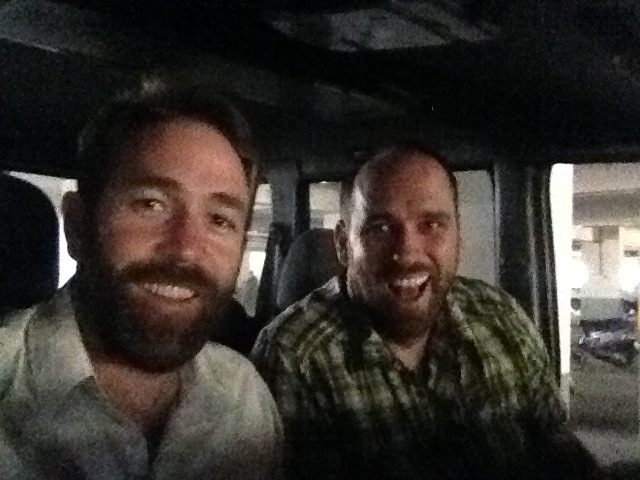
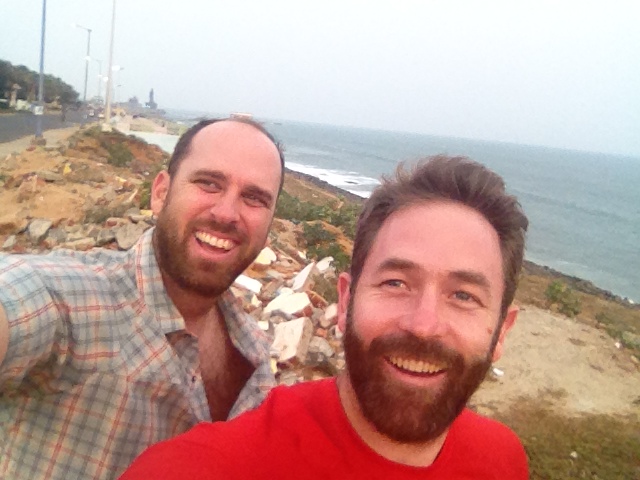
21 years later, my best friend, Matt, showed up in India, and we set off on a new vehicular adventure. This road trip took us through south India — and is as far from that night with Red Vines and Bob Marley in 1993 as we could get without leaving the Earth’s atmosphere. We loaded into The Duchess, my current diesel-powered workhorse of a vehicle, and set off on Indian roads to reach the end of the country. Our goal was to drive to the southern-most tip of the country, where three bodies of water — the Bay of Bengal, the Arabian Sea, and the Indian Ocean — come together. Fittingly, Bob Marley’s music inaugurated our first day of driving.
Matt arrived here just after the eight-month anniversary of my arrival in Chennai. He’s my first visitor. I’d heard others here talk about the significance of your first visitor, but I hadn’t thought about it much. Then I saw him walk through the doors at the airport when arrived. It was both familiar, like, “oh, hey Matt,” and remarkable, as in, “holy shit, Matt just walked out of the airport in Chennai to visit me!” What I get now is your first visitor is a huge deal, and it is appropriate that Matt was the first to visit me here.
One of the things that makes Matt great is that he’s someone who Shows Up. He has a long record of this, as his wife, his friends, his family can attest. He downplays this part of himself a bit — it’s not a big deal, that’s just how he’s wired, he’d say — but those of us who know him recognize that to show up like he does requires thoughtfulness and decision-making which few people possess. He’s really good at it — this is his super power.
We drove nearly 1200 miles from Chennai to Kanyakumari and back, along “highways” that were three-lanes wide in some places, but later would reduce to dirt roads at times. There was literally a part of “National Highway – 7” where we crossed a dry river bed (thank goodness there was no monsoon this year) that was around half a mile wide. We needed each other for this — I needed him to navigate; he needed me to drive, and it worked out perfectly. For five days in a row, in the second-most populated country in the world, we saw no westerners (save one American woman who was running one of the hotels we visited). We drove through dusty villages, major urban centers, rice paddies, plantations of coconut trees and banana trees, fisheries, a nature sanctuary, and wind farms. At our terminous, we gazed out at the beginning of a hemisphere of water that extends south of India and continues all the way to Antarctica. It was empowering to drive there, and the view of such an expanse of water was like looking into the Grand Canyon — I felt very humbled in that space.
The last time Matt and I spent this kind of time together — eight days in a row — we were in high school. I posted to Facebook that there will be a time in our lives, perhaps in another 21 years, when we talk about that time we road-tripped through southern India together. When I wrote that post I was a little flippant. There’s gravity to that feeling now, and while I know that the experience we had together — including all the things we talked about, the advice we gave each other, the old things we laughed about, the new things we puzzled out together, the close-calls on the road, and the glee each of us felt upon reaching our destination — will mean different things to me with time and reflection, I feel intense gratitude to him and for the incredible power of Showing Up.
Matt showed up. In India! And neither of us will never be the same again. நன்றி!
Toughness
Two years ago this week my cousin was in a terrible job-site accident. He worked as a heavy crane operator, and one morning he was crushed between a steel beam that weighed around 10,000 lbs and a large pile of dirt. Somehow, he survived the initial impact. He also survived nearly suffocating because dirt filled his mouth and nose on impact. He made it through maybe 20 surgeries on his knee, shoulder, hips, back, and he fought off sepsis, plus a few other major life-threatening incidents. My count is unofficial, but I think he stared down Death at least five times. He’s by far the toughest person I know. Also the most stubborn. Thank goodness for that; I’m sure it kept him alive.
I’m thinking about him today because of the anniversary of his accident, and because I’m sick, again. For awhile today I was feeling sorry for myself. I’m sick and uncomfortable. My cousin has had to learn to walk again. I’m living in India; he had to live with his parents for over a year while he started his recovery. Parts of his body were destroyed, and he’s had to figure out how to make them work again. I don’t like my food options while this thing works its way through my system. He keeps getting up and defying the odds. I worry if I’ll be well enough to go back to work tomorrow. He’s a miracle. I’m just sick.
In one of his poems, Wendell Berry writes, “Practice Resurrection.”
I’m really glad you’re still here, KS.
More Virtues: Resolve, Frugality, Industry
In the past three weeks I’ve done three more of Franklin’s virtues: Resolve, Frugality, and Industry, but I didn’t post anything about any of them until now. What follows are some thoughts about each.
February 1, 2014. Last week’s theme was:
Resolve: Resolve to perform what you ought; perform without fail what you resolve.
It was a week of getting stuff done! I’ve noticed again and again how important the intention of these practices are. I regularly make to-do lists — in fact, you could track a lot of my movements by the trail of crumpled up slips of paper with crossed out statements and scribbled notes that I leave behind. What’s different about the Resolve experience for me is I find myself consciously putting fewer items on those lists, because I know that if it goes on the list, I’m going to finish that task. Previously, my to-do lists were more like a catalogue of wishes, as in “I wish I could get all this stuff done today.” I’ve joked that sometimes I put things on my to-do list that I’ve already done just so I can cross stuff off in order to make myself feel productive.
Resolve is moving me in a different direction. The week is over and as I look back on it, I see that there were some missed opportunities to take effective action, and I am aware the extent to which this new, intentional energy came in conflict with old patterns of waiting to see what happens. I’m grateful to be able to see this point of conflict — it gives me something to be really conscious of in the next round of Resolve thirteen weeks from now.
February 2, 2014. This week’s virtue is:
Frugality: make no expense but to do good to others or yourself; i.e., waste nothing.
(My good friend, Walter, absolutely loves this one — here’s to you WTM!) As I see it, I have a tendency to covet and even hoard the things I that I feel are in short supply. It’s easier to see this dynamic in other people than it is to see it in myself, and there’s no greater place to see the long-term impact of scarcity than India. One of the theories about why no one waits in line and everyone insists on being next is that there is a very long history of too many people for the resources that exist here. So, if you don’t go get yours, there won’t be any left. I know a lot of expats have a hard time with this cultural difference from their home countries,, and I think if you fail to recognize the genesis it, you’ll never be able to really get comfortable here.
This scarcity reaction, as I think about it, also offers me a chance to compare my own motivation against this backdrop. Do I ever act like something I want is in scant supply? – are you kidding — that happens often. It’s been sobering to compare myself — one of the winners of the world-wide lottery because I was born into a time and place where safety, health, and education are common expectations — to most of the people I live around, who appear to be scraping to survive a lot of time, and who don’t think about safety, health, and education in a way that I do. Looking outward whether I’m in India or in North America, I recognize that whatever it is that we want more of — food, money, love, travel, professional opportunity, clothes and shoes, nice furniture, praise, etc. — we can’t get enough of, and despite what’s in front of us, we think it’s scarce and we fear it will be gone soon. Turing the focus inward, I see my own patterns fairly clearly. So, I’m imagining a shift, and although I’m not sure what it will look like, I’m excited to move into this space.
It’s been my intention write about the week after it happens, but in this case, I’m going to put a question out there because I know it will be a challenge, and I think stating it this way will make me more likely to rise to meet it. The question is this: How would I behave differently if I told myself that I have enough?
Post- Frugality Week, February 7, 2014 – looking back on the week, I wish I had more time with Frugality. It turns out that my question about behaving differently if I told myself I have enough was really tough to process in some situations. For example, it was easy to not waste money or food, but I found that I wanted to spend my limited time — my most precious resource — with people. It was very hard to walk away from the chance to talk with someone and go do something else like work. There’s always more work to do, so given a choice, I’d much rather talk with someone I don’t have that much opportunity to see, or engage with someone I know well about new ideas or revisit old conversations. Whether just catching up or talking about the complexities of shifting a school curriculum to be completely focused on student inquiry or working through the emotional territory of being far from the familiar, I like the conversations; I want more. My superintendant here often tells us that “learning is social.” I might be using that idea to justify more socializing — seemingly, I can’t get enough of that.
February 15, 2014. So it’s fitting that the next virtue, Industry, follows my experience with Frugality. Franklin says:
Industry. Lose no time; be always employ’d in something useful; cut off all unnecessary actions.
This was the hardest of the virtues for me to practice, for as I wrote earlier, I like socializing. In my defense, I process my work that way, and often my best ideas for my classes come through conversation about students, books, and curriculum. So there’s a tension here for me that I’ve felt for the past two weeks because it sometimes is difficult to separate hanging out from laying the groundwork for something great. Learning is social, afterall.
I was able to make some easy decisions about being industrious — I limited my Facebook and online news reading dramatically. This created time for me especially in the morning to accomplish more than I’d be able to recently because I’d previously been lying in bed reading. Being aware of how much time I spent online made me see how important it is for me to maintain a connection back to the U.S. I’ve followed several stories back home ranging from the snow on the East Coast to the social and political dynamics of sports and entertainment industries. Perhaps I wouldn’t miss these things if I didn’t have access to the Internet, and I’m aware of the comparative experience of my dad and his Peace Corps friends in Nepal in the mid-60s who all wrote home regularly despite having to wait weeks and weeks for responses. Interesting comparative statistic: I’ve received exactly one piece of mail here in nearly seven months.
Unfortunately, I haven’t written much these past few weeks. Franklin would likely frown at my for this. Partly I was away from my writing because I was trying to be more industrious at first, but it got away from me a little and soon I was not writing because I thought I needed to do other things more in line with getting stuff done. Balance is key and perhaps the whole point of these virtues. It’s early — I’ll get several more shots at this theme and this balance thing in 2014.
6 Month Anniversary!
January 24th marks the six-month anniversary of my arrival in Chennai. If I was truly in the spirit of India, I’d take the day off and burn all sorts of materials in honor of the occasion. Unfortunately, I need to go to work. I’ll let this post be my virtual puja, and I’ll make it concise. A short list of the important things I’ve learned in my six months on this wonderful subcontinent:
1. Take the antibiotics.
2. Car horns should be used in a call-and-response technique: you hear a horn, you honk your horn.
3. You always have the right of way. Always.
4. The next holiday is the biggest one of the year. Until the one after that.
5. India’s time is more important than your time. No exceptions.
6. Everything is paradoxical, i.e. everyone is in a hurry, and nothing starts on time.
7. Dance. Indians love it. It’s just better if you do, too.
13 Virtues

I have brunch on Saturdays with a new but close friend of mine here in Chennai. I’ll call him J here. J and I connect about a variety of things when we hang out, but there’s a constant theme that emerges each Saturday of the desire for personal improvement. For each of us, the move to Chennai was about inviting change into our lives and fully embracing that new energy. Both of us thinks it is important to establish here regular practices that invite more richness and opportunities for reflection into our lives. So, in partnership with J, we’ve borrowed several pages from Ben Franklin’s guide to life and are setting off in 2014 to live according to his 13 virtues.
Franklin established his thirteen virtues as a way to shape his life in pursuit of excellence while achieving balance and moderation. While he practiced all of them concurrently, J and I will focus on practicing one per week for the next year. It starts with Temperance: eat not to dullness and drink not to elevation. The next one was Silence: speak not but what may benefit others or yourself; avoid trifling conversation. For me, these weeks were amazing.
During the Temperance week I was quickly aware of the challenge I faced: food. Despite not missing more than perhaps a dozen or so meals in my life, and never more than one in a row, I grew up thinking I had to eat as much as possible because I didn’t know when the next round of food would turn up. Not drinking is easy for me because I can think about alcohol as a special occasion sort of thing, but I eat at least three times a day. I was concerned at first, but I was doing great. I even recognized quickly how eating less at certain points in the day resulted in more energy at other times. “Hey, I like this,” I thought.
Then came Wednesday.
On Wednesday I decided that I needed to let go of something that I’d been holding onto tightly for a long time, and it was hindering me in a couple of noticeable ways that I couldn’t avoid any longer. I decided it was time to let it go, and I figured I needed to be somewhat ritualistic about it: I wrote a letter, reworked it a few times to get it just right, and symbolically put it out there. Although I didn’t like it one bit, I noticed a release. That night, I wanted to eat the world. Hello Temperance!
I was feeling lots of emotions, and I wanted to cover them up with delicious little (and big) bits of something that would make me feel better. Yikes. I don’t know if I’d have recognized all this if I hadn’t been following Franklin’s lead. Upon further reflection, it turns out that food is a crutch I’ve used more than I realized. This was an keen awareness to notice and feel in real time and to see in retrospect.
The weekend came, and the next up on the virtue list was Silence. I was slightly uneasy on the onset of this virtue of the week because I already knew that one of the few things I do more than eat is talk. The week was indeed a struggle — I constantly second-guessed myself about what I was saying. One example comes from a meeting I was in late in the week where I was evaluating a process at my school that involves both teachers and students, and I felt challenged in a moment I wouldn’t have even thought about previously. Normally, I’d strike like a lightning bolt at the main issues; this time I had to evaluate carefully what I wanted to say and whether it was going to benefit myself or others. I paused a long time — enough for the storm of thoughts to smooth out a bit in my mind. I’m still not sure if I got on the right side of Silence in that conversation, but a new pathway was formed, at least partially, last week.
I’m just over two weeks into this, but here’s what comes to mind right now: Franklin’s virtues were about striving for moderation. While I knew moderation was his goal coming into this practice, what I’m now feeling quite acutely is that moderation requires a level of mindfulness — constant mindfulness, in fact — that I’d completely underestimated. I’m someone who meditates a lot, I’ve been on a couple of lengthy silent retreats, and I even once traveled to other countries seeking meditation practices. I thought I was dialed into mindfulness. Following Franklin has invited a “walking consciousness” that I hadn’t expected when I started with this experience. One virtue a week has seemed to sharpen my awareness to little moments in real time where the shifting is occurring. Little moments, but the impact is anything but small. And as an added benefit, at the end of the week, I don’t want to let go of the previous week’s virtue. They naturally build on each other and stick around. That Franklin was onto something.
Telemachus


On New Year’s Day, my dad, my brother, and I launched Telemachus, a 17 foot bay kayak in Mission Bay, San Diego. We, with help from my grandfather, built this boat over the course of the past three years.
Telemachus’ namesake is the son of Odysseus, the hero of Homer’s Odyssey. He gets forgotten about a lot, but his story is important. The Odyssey is usually remembered the epic as the story of Odysseus’ return home to Ithaca. It’s easy to forget that it begins with Telemachus’s journey to find his father, a man Telemachus has always heard about, but never met. He outfits a ship and sets sail seeking answers.. Sometimes Telemachus’s journey, catalogued in the first three books of the story, is called the “Telemetry.”
Telemetry is usually associated with space exploration in modern western culture — it loosely translates to something like “collecting data or information from remote places.” A more literal translation of the Greek roots comes out as “far from war.” Both are fitting: Telemachus grew up during the time of Trojan War, but he was just a boy during all of the fighting that took place so far away from his home, where he lived with his mother — both waiting for Odysseus to return. Telemachus attempts to live up to the honor of Odysseus, and his grandfather, Laertes — two icons of strength and achievement in the Argive world. Telemachus’ journey is ostensibly to find his father, but it’s also to discover himself. I wonder if he knew he was searching for his own identity when he set sail, or if he imagined his journey would change him forever.
The story of Telemachus the kayak is not nearly as dramatic in reputation and action, but it served a similarly defining purpose for me. I named it specifically to evoke the context of the right of passage that comes from learning more about one’s patriarchs, and thereby, learning about oneself. Originally seen as a cool project for father and sons, this boat quickly emerged as an important symbol. It is the only project that had three generations of Ransons working on it, my grandfather, my father, my brother, and all had a role in turning this pile of materials into a swift-hulled boat.
Telemachus took a long time to complete, sort of like how long it took Telemachus to seek his father in the story. There were successes and setbacks around each turn. The additional time was in the end a gift, for it offered more opportunity for connection and time with each other than was originally planned. The accidental developments in the end were the most valuable parts. The boat is beautiful, and it handles so smoothly in the water. We’re all proud of the work we did, happy the way it turned out. I’m most pleased though that I get to say, “I worked on that with my dad, my grandpa, and my brother..”
Telemachus set out to discover what happened to his father, and in the end he found himself. That’s just how it goes.
5 Months In
My first semester teaching in India is in the books. In a few hours I’ll be headed back to San Diego for the holidays. Visions of tacos dance in my head.
Christmas Eve will mark the five-month anniversary of my arrival in Chennai. It will also be the one-year anniversary of the day I accepted the position. [Insert pithy comment about how quickly time passes here.]
Time, in it’s basic sense, is a measurement of distance traveled. The past year has been a long, cathartic journey for me, while the past five months feels like such a short, intense blip of a memory already. Five months from now I’ll be wrapping up the end of the school year here. I hope it goes as well as the past five months have gone.
Reading the last sentence is strange for me. I know that the past five months have been really challenging — some of those challenges have appeared in the entries of this blog. I haven’t forgotten how much I’ve given up to be here. If anything, finishing the semester has helped me see some of the challenges I faced a little more clearly. One example: I am teaching three different preps this year, and I’ve only taught two readings — a poem and an essay — that I’ve taught previously. When I recognized that I felt an intense no wonder I’m so tired jump out of me.
The past five months have forced me to grow in ways that I imagined before I got here but couldn’t have really understood or specifically anticipated at any point over the last twelve months. I’m reminded of Socrates, who talks in “The Meno” about the different ways of knowing. He uses knowing how to get to a city called Larissa as an example. He says you can learn from hearing the directions and experiences from someone who has been there, or you can go yourself. Both ways represent a certain type of knowing, but in my opinion, the differences are so great that there are hardly any similarities between the theoretical and experiential knowledge. When I started my own journey I expected to be challenged personally and professionally, and yet when I finally arrived I was often surprised to feel so completely unprepared despite thinking about it constantly for months and months. But then there were other times, such as when I’ve driving through the chaos called traffic on my way home from school, when I think “This place is a piece of cake.”
Maybe it is a piece of cake, Indian style. It’s a bigger piece than I imagined. And it doesn’t come when I expected it. And it tastes different. It’s good though. Really good.
Delhi Belly
(Disclaimer: if “bathroom” humor offends you, please stop reading here — and pass your computer to the nearest 10 year old.)
I’m sick.
I’ve been working really hard lately. I’m not saying that to brag or to make it sound like others don’t work hard, but rather to indicate a sort of base line for what comes next. Most of the in-the-classroom stuff all stems from one question: how do I meet the needs of my students? The outside-the-classroom but inside-the-school stuff reduces to questions like “how does this meet the needs of our community?” and “what’s the next right thing that I or we can do here?” The questions are easy to ask; the answers are bears to wrestle with. I was wrapped up in complex conversations trying to solve all the problems in the world last week, more than normal. There was a GoGoGo! pace to things that left me flattened by Friday and into Saturday. And Sunday.
So it’s against this backdrop that I got sick. Maybe I was working too hard and not taking care of myself well enough. Maybe I just got unlucky with something I ate and that’s all there is to it. At any rate, I’ve been a prisoner to my apartment and the little plastic and porcelain toilet for much too long now. I had food poisoning about a month into my tenure here, and that came and went within 24 hours. There was another week when I had a mild case of something not being right — I felt icky enough to be slowed down but not bad enough to stop and be still. I labored through school for several days, finally took some antibiotics and was right as rain in a flash.
This is different. I have full-throttle Delhi Belly. The kind with loud music and dancing. Unfortunately, it’s not entertaining. The music is the sounds coming from my body in the echo-chamber of my bathroom, and the dancing are the gyrations I’ve been going through to get from the couch or bed into the bathroom while taking off my shorts at a sprint with less than a moment’s warning. Yikes. You know how it is — going from groaning stillness to Flash Gordon fast just like that, hoping you make it in time. It’s always awful, but somehow this is the worst. How bad could it be? Funny you should ask. Guess which one of these is NOT true of me over the last day.
– I’ve done a Google search for “pee coming out of butt”
– I’ve researched to see if there’s a Hindu god of the toilet or the scatological.
– I decided to visit the food shop seeking yogurt and bananas on the first floor of my building only after calculating how long it would take me to get to the shady toilet in the pool locker room on the same floor in case I have to make a mad dash for it.
– I prayed for an old-time, cold, glass bottle of 7up, the kind I was only permitted baby-sips from when I was sick as a kid, in hopes that between the substance or the nostalgia it might bring some relief to my innards.
– I celebrated the noxious burps that quickly followed drinking soda water. My goodness, the release of that gas is so great.
– I’ve considered only eating rice and warm milk for the rest of my life.
– I’ve looked into jobs in Denmark, France, and Luxembourg, because the idea of eating only cheese sounds like heaven compared to going back to whatever curry dish did me in.
Okay, they’re all true. I’ve had a lot of time by myself and my imagination may have run amok. Interesting note though: There isn’t a clear Hindu god of the toilet, per se. But there may have been a Roman god of flatulence (Crepitus). Seems a little like fiction: Romans didn’t have that kind of sense of humor, did they?”
Having to “run” to the toilet 10-15 times during the day evokes a certain way of seeing things. It’s hard not to laugh a little at the pure grossness of having such vile matter projecting itself from your body. It’s like this stuff has an attitude of “I’m so repulsed by you that I’m getting out of here, fast.” Note to disgusting mess in the toilet bowl: you weren’t invited! I also find my moments of gratitude stacking up like cars, buses and motor-bikes waiting to make a right turn on the highway outside my house: I’m grateful for the soda-induced burps and the harmonies of flatulence (there’s a few select individuals reading this who I know are into fart noises — it’s really quite amazing). I am grateful for the inane and the particular corners of the Internet, for they have helped me find this video, which gave me hope to one day move again with joyous abandon without fear of leaking. I’m happy that I’m not alone (according to Yahoo! Answers) in my symptoms but that I’m also very much alone in my execution. I’m also so grateful that this isn’t happening on a Indian train, because that would truly be the worst thing I can imagine right now. The worst.


 ransonnotes